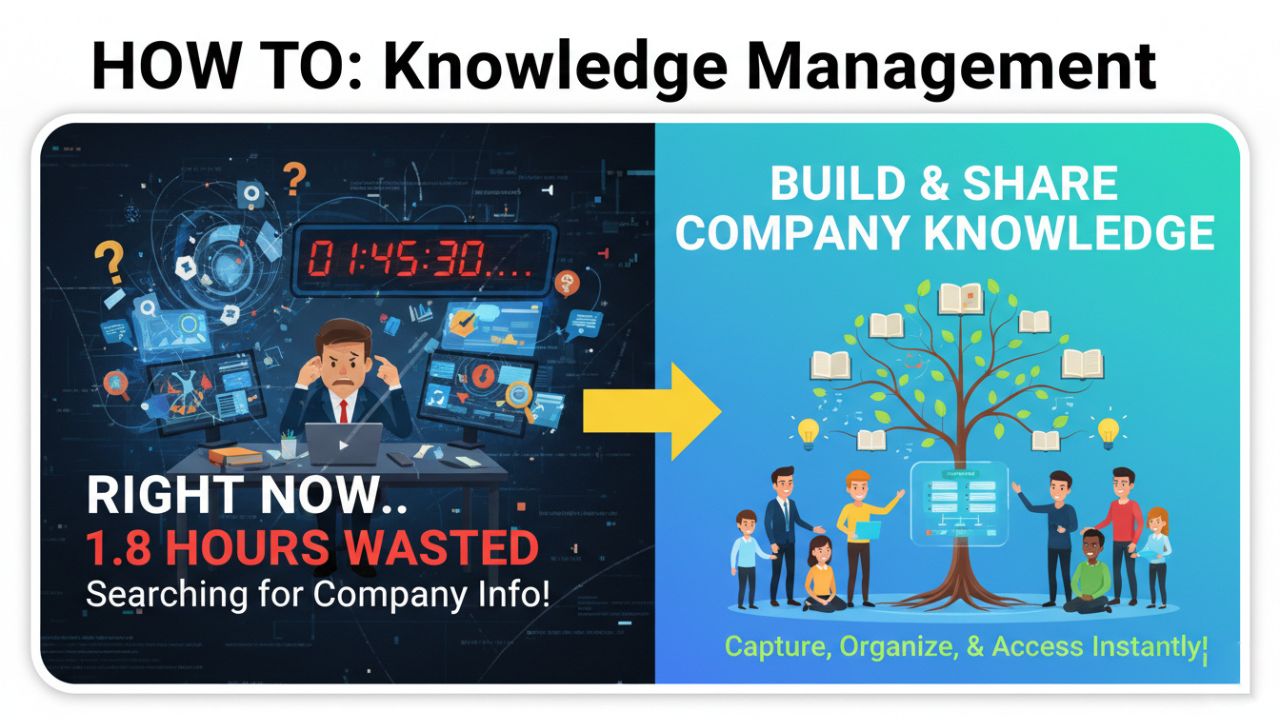
Right now, while you're reading this, your employees are wasting 1.8 hours searching for information that should be at their fingertips.
Not tomorrow. Not last quarter. Right now.
If you have 150 people on your team, that's $750,000 in lost productivity every single year. And when someone quits? 42% of their job-specific knowledge walks out the door with them, never to return.
Here's the brutal truth: your company is hemorrhaging money and expertise, and most leaders don't realize it until it's too late.
Why This Matters More Than Ever (And Why Right Now)
The knowledge crisis isn't coming, it's already here.
With Gen Z workers averaging just 2.3 years at a company and 42% of critical knowledge locked inside individual employees' heads, you're sitting on a ticking time bomb. Fortune 500 companies lose $31.5 billion yearly from poor knowledge sharing. One thousand employees? That's $4.5 million wasted annually.
But here's what keeps me up at night: 55% of knowledge management initiatives fail completely. Organizations pour millions into fancy software only to watch it become a digital graveyard within months.
The difference between the 45% that succeed and the 55% that fail? It's not about having the fanciest technology or the biggest budget. It's about execution.
By the end of this post, you'll know exactly how to build a knowledge system your team actually uses, one that delivers measurable ROI within months, not years.
What Changed Everything: When Compliance Met Innovation
Something remarkable happened in 2015 that transformed knowledge management from a "nice-to-have" HR initiative into a non-negotiable business requirement.
ISO 9001:2015 introduced explicit knowledge management requirements for the first time in history. Suddenly, over 1.1 million certified organizations across 189 countries had to systematically identify, maintain, and make knowledge available.
This was validation. Organizations implementing ISO frameworks now report 15-25% improvements in return on capital, 40-50% reductions in audit prep time, and measurable improvements in knowledge retention.
Then AI entered the picture in 2024-2025, and everything accelerated.
The convergence of proven ISO frameworks with AI-powered solutions like RAG (Retrieval-Augmented Generation) created something unprecedented: world-class knowledge systems that deliver both compliance and competitive advantage with implementation timelines dropping from 9-12 months to just 1-5 months.
The Three Deadly Mistakes That Kill Knowledge Systems
I've watched brilliant companies make the same three mistakes over and over.
Mistake #1: Starting with technology instead of problems. They buy platforms before understanding what specific pain points they're solving. The software sits unused while employees continue emailing attachments back and forth.
Mistake #2: Underestimating change management. They assume "if we build it, they will come." Spoiler: they won't. Without sustained leadership commitment and user involvement from day one, adoption flatlines within weeks.
Mistake #3: Treating it as a project, not a program. They celebrate the launch, then move on. Six months later, the system is outdated, and nobody remembers how to use it.
Sound familiar?
These failures are preventable. Organizations following proven frameworks see transformative results: 20-25% productivity gains, 40% reductions in turnover, 32% faster issue resolution, and up to 411% ROI over three years.
The Framework That Works
Here's what separates winners from the 55% that fail: a systematic approach that balances people, process, and technology.
Start With What Hurts Most
Don't try to document everything. Start with one high-impact area where knowledge gaps cause visible pain, lost deals, repeated mistakes, slow onboarding, whatever keeps your team frustrated.
Map the critical knowledge flows: where it's created, how it moves, who needs it, where bottlenecks exist. This isn't academic, it's surgical. You're identifying exactly where knowledge loss threatens your operations.
Build on Proven Standards (Even If You Don't Certify)
ISO 30401:2018 provides the comprehensive framework that most organizations desperately need but don't know exists. You don't have to certify, but the structure works.
The framework distinguishes between two types of knowledge that require different approaches:
Explicit knowledge (procedures, policies, data) belongs in systems. Document it once, maintain it systematically, make it searchable.
Tacit knowledge (intuition, expertise, context) lives in people. Connect them through mentoring, communities of practice, and expert directories.
Organizations implementing ISO frameworks report something remarkable: they stop treating documentation as a compliance burden and start seeing it as strategic infrastructure.
Design Around How People Actually Work
This sounds obvious, but most organizations violate it immediately.
They design knowledge systems around org charts or how executives think work should flow, not how it actually flows. When Philips transformed knowledge management across 80,000 workers in 17 markets, they succeeded because they built systems that saved account managers "multiple hours per week" in their actual workflows.
Workshop-heavy from day one. Your users must guide efforts from design through implementation. Not survey them once—involve them constantly.
Leverage AI Without Losing Your Mind
Here's where it gets exciting: AI-powered knowledge management in 2025 isn't science fiction, it's practical and affordable.
RAG (Retrieval-Augmented Generation) architecture combines the reasoning capabilities of large language models with real-time retrieval from your company's knowledge. When someone asks "What's our policy on remote work for international contractors?", the system:
- Converts the question into a searchable format
- Retrieves relevant policy documents from your knowledge base
- Generates a natural language answer with explicit source citations
- Delivers results in seconds instead of hours
Organizations implementing hybrid search (combining keyword and semantic search) report 49% improvement in retrieval quality, jumping to 67% with advanced reranking.
But here's the critical part: AI is an enabler, not a replacement. Without solid KM fundamentals like governance, content ownership, user adoption. AI just helps you fail faster.
Implement in Phases That Show Value Fast
The most successful implementations follow a proven pattern:
Phase 0 (Months 1-3): Assessment and Foundation Conduct capability assessment. Identify business imperatives. Secure executive sponsorship with projected ROI. Select pilot department based on business impact and engaged users. Establish baseline metrics.
Phase 1 (Months 4-6): Pilot Implementation Launch with 90% of initial content already uploaded and cleaned. Train thoroughly. Gather feedback systematically. Celebrate wins loudly.
Phase 2 (Months 7-9): Iterate and Expand
Analyze metrics against baseline. Make platform improvements. Document lessons learned. Begin phased rollout.
Phase 3 (Months 10-12): Scale Organization-Wide Complete rollout while maintaining adoption focus. Implement AI-powered features. Establish ongoing review cycles.
Phase 4 (Ongoing): Optimize and Mature Conduct quarterly content audits. Monitor analytics. Evolve continuously.
The Numbers That Make CFOs Pay Attention
Let's talk money, because that's what gets resources allocated.
The Search Time Problem: Employees spend 1.8 to 3.6 hours daily searching for information (IT workers hit 4.2 hours). That's 30% of the workday spent hunting rather than creating value. Cut search time in half at a 150-person company earning $60K annually? You save $750,000.
The Turnover Crisis: Losing an employee costs up to 213% of their salary when you factor in replacement efficiency. Organizations with strong KM programs see 40% reductions in turnover. The savings are staggering.
The Customer Impact: Companies with effective enterprise knowledge systems achieve 32% faster issue resolution, 28% improvement in Net Promoter Scores, and 42% increase in service consistency.
Real-world proof: Dell's Asset Recovery Business transformed from operating losses to profitability with 40% growth in one year through ISO 9001-based knowledge systems. Welspun Corp went from unknown domestic manufacturer to world's largest line pipe producer.
What Success Actually Looks Like
Philips needed to transform from product-based to solution-based business across 80,000 workers, 17 markets, and 30+ businesses.
Account managers wasted hours daily searching for articles, white papers, case studies, and expert contacts across fragmented systems. This prevented the strategic shift to selling integrated solutions.
Their approach combined classical and AI-powered KM. They implemented intelligent tagging connecting workers to relevant content, communities, and experts. Critically, they designed around actual sales workflows, not organizational structure.
Results: Account managers saved multiple hours per week. Cross-market collaboration accelerated. Innovation-to-market timeline decreased through knowledge reuse.
The difference from the 55% that fail? Better execution of fundamental principles: clear business problem, user-centric design, appropriate technology, strong governance, sustained leadership support.
The Quick-Start Action Plan You Can Implement Monday
Ready to begin? Here's your prioritized roadmap.
This Week:
- Identify your executive sponsor (someone with authority and passion)
- Calculate current knowledge loss (employees × hours searching × hourly rate)
- Select one high-impact pilot department with visible problems
- Schedule workshops with pilot users to understand actual workflows
Weeks 1-4:
- Conduct knowledge capability assessment (APQC offers free frameworks)
- Map critical knowledge flows and bottlenecks
- Define 3-5 clear success metrics with baseline measurements
- Establish governance: board, business owners, implementation team
- Choose your platform based on actual needs (Confluence for technical docs, Notion for flexibility, SharePoint for Microsoft integration)
Weeks 5-12:
- Clean up content for pilot scope (aim for 90% completeness before launch)
- Configure platform and integrations
- Develop content templates for common scenarios
- Train content owners and pilot users thoroughly
- Create communications plan explaining the why
Launch and Beyond:
- Soft launch with marketing campaign
- Gather feedback weekly through surveys and conversations
- Make rapid improvements based on data
- Celebrate early wins publicly
- Scale systematically based on lessons learned
The Technology Stack That Makes It Happen
Modern implementation requires smart tool selection.
For Core Platform:
- Confluence ($6.05/user/month) for technical teams with hierarchical needs
- Notion ($10/user/month) for all-in-one flexibility
- SharePoint (included in M365) for Microsoft-centric enterprises
- Document360 ($149/month+) for customer-facing documentation
For AI-Powered Enhancement:
- Claude 3.5 Sonnet for reasoning capabilities
- GPT-4 for general queries
- Voyage AI or OpenAI embeddings for semantic search
- Pinecone, Weaviate, or Qdrant for vector databases
For Compliance and Standards:
- CloudQMS, isoTracker, or SimplerQMS for ISO 9001/30401 implementation
- Cost: $100-500/user/year (far less than traditional systems)
- Implementation: 48 hours to 5 months depending on complexity
The Risks That Sink Initiatives
Every knowledge management implementation faces predictable risks.
Content quality risk kills slowly. Systems fail when users encounter outdated, inaccurate, or duplicate information. Solution: Implement automated review cycles with ownership accountability. Conduct quarterly audits identifying Necessary, Erroneous, Redundant, and Dated content.
Adoption risk stems from poor change management. Organizations excelling at change management see 88% higher project success rates. Solution: Comprehensive communication, role-specific training, employee involvement, feedback mechanisms, recognition programs, and champion networks.
Security and compliance risk grows with AI. Organizations using role-based access control experience 42% reduction in data breaches. Solution: Implement RBAC from day one, add PII detection for AI systems, ensure GDPR/CCPA/HIPAA compliance as needed.
Technology complexity risk causes abandonment. 36% of organizations have three or more KM tools, creating confusion. Solution: Consolidate functions, integrate with existing tech stacks, start simple.
Sustainment risk emerges after launch excitement fades. Solution: Establish permanent KM leadership with ongoing budget. Knowledge management is a program, not a project.
Why the Knowledge Management Market is Exploding
The knowledge management software market reached $13.7 billion in 2025 and is projected to hit $32.15 billion by 2030, growing at 18.6% annually.
This isn't hype. It's organizations realizing that knowledge is their most valuable asset and knowledge loss is an existential risk.
With 42% of job-specific knowledge locked in employees' heads and average tenure plummeting, companies face a stark choice: build systems that preserve and amplify knowledge, or watch competitive advantage walk out the door every time someone resigns.
The winners treat knowledge management as strategic infrastructure. They they create systems where knowledge flows naturally, people find what they need within seconds, and expertise amplifies across the organization.
Your Competitive Advantage Starts Now
Here's what I've learned from fifteen years implementing knowledge systems: the organizations winning in 2025 aren't the ones with the fanciest software or biggest budgets.
They're the ones that start with real business problems, show value quickly with focused pilots, measure relentlessly, and maintain long-term commitment. They build for how people actually work, not how they wish people worked. They make contributing easy and finding information effortless.
Your employees are spending 1.8 hours daily searching for information that should be instantly available. Your departing employees are taking 42% of their job-specific knowledge with them. Your customers are getting inconsistent answers because knowledge is scattered and siloed.
These aren't acceptable costs of doing business but solvable problems.
The question isn't whether to invest in knowledge management. That ship sailed. The question is whether you'll be among the 45% that succeed or the 55% that fail.
The difference is execution, not intention.
Start Monday with a focused pilot. Prove the value. Scale systematically. Your future organization depends on the knowledge you preserve and share today.
Because the next time someone walks out your door, they shouldn't take your competitive advantage with them.
Dejan Majkic